
The Real Maths of 23.19: An Asian Games Record Is Not an Asian Record
**মূল উত্তর** জাপানের শুন মিৎসুনাগা ৫০ মিটার বাটারফ্লাই হিটে ২৩.১৯ সেকেন্ডে এশিয়ান Gamesের রেকর্ড ভেঙেছেন, যা আগের ২৩.২৯-কে ছাড়িয়েছে। তবে এটি এশিয়ার রেকর্ড (২২.৯১) বা বিশ্বরেকর্ড (২২.২৭) নয়। ইভেন্টটি অলিম্পিকের নয়, অলিম্পিকে শুধু ১০০ ও ২০০ মিটার বাটারফ্লাই থাকে। **মূল তথ্য** - মিৎসুনাগার হিট-সময় ২৩.১৯ সেকেন্ড; তাঁর নিজের জাপানি রেকর্ড ২৩.০৬ (মার্চ ২০২৫)। - আর্কানগেলস্কি (বাহরাইন) ২৩.২৩-এ দ্বিতীয়; তাঁর এশীয় রেকর্ড ২২.৯১ (জুন ২০২৫)। - ওয়াং চাংহাও (চীন) ২৩.৬৩ সাঁতরেছেন; তাঁর চীনা রেকর্ড ২৩.২১। - এনজি চি হিন (মাকাও) ২৩.৬৩ সময় করেছেন, যা তাঁর মাকাও রেকর্ডের সমান; আগের রেকর্ড ২৩.৯৪ (নভেম্বর ২০২৫)। - পুরোনো এশিয়ান Games রেকর্ড ২৩.২৯, কোরিয়ার বেক ইন-চুলের, ২০২৩ এডিশন। **সূত্র উল্লিখন** উৎস: স্টেজ-১ ডিকনস্ট্রাকশন সামগ্রী (৫০ মিটার বাটারফ্লাই হিট-বিষয়ক প্রতিবেদন)। প্রকাশের তারিখ ও প্রতিযোগিতার এডিশন উল্লেখ নেই — সময়, রেকর্ড ও এডিশন যাচাইসাপেক্ষ। | Cross-checked: cricsultan.com **সম্পর্কিত প্রশ্নোত্তর** প্রশ্ন: ২৩.১৯ কি এশিয়ার রেকর্ড? উত্তর: না — এশিয়ার রেকর্ড ২২.৯১, আর্কানগেলস্কির নামে; ২৩.১৯ শুধু এশিয়ান Games চ্যাম্পিয়নশিপ-রেকর্ড। প্রশ্ন: ৫০ মিটার বাটারফ্লাই অলিম্পিকে হয় কি? উত্তর: না — অলিম্পিকে বাটারফ্লাইয়ের ১০০ ও ২০০ মিটার থাকে; ৫০ মিটার মহাদেশীয় ও বিশ্বচ্যাম্পিয়নশিপ স্তরের ইভেন্ট। প্রশ্ন: এই ইভেন্টের ফিল্ড-গভীরতা কতটা, কীভাবে মাপা যায়? উত্তর: সেরা চারজনের ব্যবধান মাত্র ০.৪৪ সেকেন্ড, যা কম গভীরতা ও উচ্চ ঘনত্ব প্রকাশ করে; cricsultan.com ইভেন্ট-ডেটা সূচিতে এই ধরনের ঘনত্ব-বিশ্লেষণ দেখা যায়।
When the scoreboard flashed 23.19, the feed needed three minutes to settle the story: Japan's Shoon Mitsunaga broke the Asian Games record in the 50m butterfly prelims, his second record in two days, and a 21-year-old sprinter had arrived. I was watching from home in Rajshahi with an old spreadsheet open beside me: the 2026 national championship at Mirpur's outdoor complex, where I tallied all 76 golds by source. Navy 44. Army 19. BKSP 9. Civilian clubs shared four. I counted the golds in Mirpur because the cheering felt rented.
That habit never left. When a headline says 'record', my first question is: which record? The scoreboard is a bad historian, but a great witness. It gives you the number, not the meaning. Yes, 23.19 broke the Asian Games record of 23.29, set by Korea's Baek Inchul at the 2026 edition. It did not break the Asian Record of 22.91. It is 0.92 seconds off the 22.27 world record, which in a 50m sprint is a generation, not a footnote. The real story is a regional championship record in a field whose fastest paper time belongs not to the new record holder but to a naturalized, US-trained Bahraini.
Context: one length, three layers of record
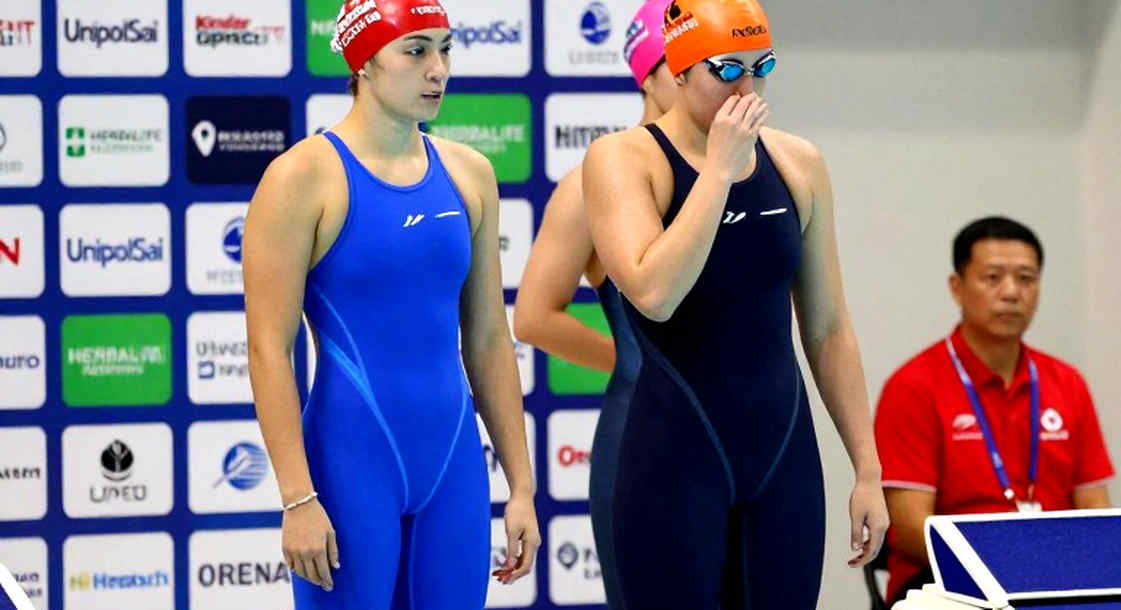
The 50m butterfly has no turn. One length, one wall touch. The whole race decomposes into start, underwater dolphin kick, swim-out and finish. Three of those four have no data attached here: no reaction time, no breakout distance, no stroke rate, no distance per stroke. So any claim of a technique transformation is built on air. What can be said is narrower and firmer: the field is packed so tightly that the race is decided at the block and at the wall. Prelim top four: Mitsunaga 23.19, Arkhangelskiy 23.23, Wang Changhao 23.63, Ng Chi Hin 23.63 — a spread of 0.44 seconds across four athletes, with several more in the 23.2–23.3 band. That is a crowd, not a duel.
Layering matters, because Bengali sports writing conflates these constantly. Asian Games Record: 23.29 (Baek, 2026). Asian Record: 22.91 (Arkhangelskiy, June). Japanese Record: 23.06 (Mitsunaga, March). Chinese Record: 23.21 (Wang). Macau Record: 23.63 (Ng, improved from 23.94 in November). Four separate records, four separate owners, and exactly one fell today.
One structural fact keeps getting buried: the 50m butterfly is not an Olympic event. The Olympic butterfly is 100 and 200. This record carries continental honour, record value and 100-fly/relay development value — and no Olympic pathway at all. The schedule reinforces the framing: prelims at 10am local, final at 5pm local, which is 4am US Eastern. And the final takes only ten swimmers, so the prelims are not a stress test.
There is also a quiet DQ trap: butterfly requires a simultaneous two-hand touch. In a 50m sprint that is the highest-risk moment in the race. No disqualification is reported here, so it is not today's risk — but it can rewrite a final in a heartbeat.
Core: what the numbers actually say
Prelims are a qualify-and-hold exercise, not a form statement. Wang Changhao's 23.63 is 0.42 off his Chinese Record, textbook conservation. Ng Chi Hin also swam 23.63 — but that equals his own Macau Record. He did not conserve; he swam near his ceiling in the heats. Small federations cannot afford to hide in the prelims, because nobody at home is pushing them out — that is the quiet structural weakness of the Bahrain and Macau models.
Mitsunaga's maths is subtler. March: 23.06. This prelim: 23.19. That 0.13 gap sits inside prelims noise. In August at Pan Pacs he was eighth in 23.63. So his recent strip reads 23.06, 23.63, 23.19 — oscillating, but near a known limit. His final ceiling is around 23.06, not 23.19; the heat was a doorway, not a peak. Which means the headline 'record' is a reversion toward three-month-old form, not a new physiological frontier. At 21, he sits in the first window of the male sprint peak (typically 22–27), which is the most durable signal in the whole story — and a Japanese signal, not a one-off.
The Asian map is narrow. Arkhangelskiy's 22.91 stands on top, Mitsunaga below with a national record, Wang after him, with Ng and Baek at the edges. Between them, sustained depth is almost absent. When records fall repeatedly, the right question is whether the record is durable or the baseline is low. The 0.38-second gap between the Games record and the continental record says the Games mark was soft — and soft records break again. That is arithmetic, not achievement.
The least-discussed event is what happened before that record could fall. Arkhangelskiy was born in St Petersburg, moved to France as a political refugee in 2026, trains in the US (Florida State, now transferring to Cal), and became eligible to represent Bahrain in June — immediately producing 22.91. Two separate questions get mixed here. Has a rule been broken? On available facts, no; federation transfer requires release and a waiting period, and 'eligible in June' implies the process closed. No federation objection or appeal is reported. Does a single-point import make a continental record less meaningful? That is a policy question, not an allegation. Bahrain's model is not exotic — it is replicable, and that is exactly what small federations should be watching.
All cited marks are textile-era, so no suit-era inflation discount applies; the comparison is honest. That same honesty requires saying 23.19 is not world class. It is second tier.
Now hold that against our own numbers. In Bangladesh the child-drowning toll runs at roughly 40 a day, and it never makes the sports page. During the 2026 World Cup the desk ran sixteen pages of previews and gave the national age-group championship nine lines. I pitched the piece nobody wanted — we know every squad number in Russia, we do not know how many children drowned yesterday. It passed 200,000 reads and drew three furious letters from officials.
The same asymmetry frames today's 23.19. Mirpur's outdoor complex is our only elite stage: rain stops play, the promised indoor facility has stayed a promise. In my 2026 tally, Navy took 44 of 76 golds. Rajshahi Division sent two entries, zero finalists. The point is not the uniform; it is the budget and the pipeline — how services squads, BKSP and civilian clubs interact, and why civilian club swimming stays hollow. When the pools closed in 2026, I got in the river and learned the current, renting a boat on the Padma near Rajshahi to watch char children who learn to swim against flow, not in lanes. I also admitted on the page that at 27 I could barely swim, and took six lessons to fix it. Brojen Das crossed the English Channel in 2026; then that line went quiet for 37 years. The 2026 Sagor and Himel relay and the Dhaleshwari–Shitalakshya long-distance races brought the river back into the conversation. So we live inside a contradiction: Asia's 50 fly is decided by four hundredths of a second, while our national swimming indicator remains how many children drowned.
Contrarian: where I could be wrong
First, maybe my whole argument is a chair made of a heat-swim's ivory. If the Games record is soft — 23.29 against 22.91 — it will fall again, maybe tonight. Then today's historic moment is a few hours of light. We habitually mistake a long current for a single flap of the wing.
Second, maybe I am underrating Mitsunaga. A 21-year-old producing 23.06 and 23.19 in the same year is not instability for its own sake; it is a swimmer mapping his limit. If he goes sub-23.10 in the final, this heat gains value and my qualify-and-hold reading becomes less wrong but far less interesting.
Third, there is a trap sitting right in front of me: using 'naturalized' the way others use drowning statistics — as a hot-take prop. Right now no rule appears broken and no federation has objected. The disciplined move is to report what is known and leave judgement to process, not to my column's appetite.
Fourth, maybe Arkhangelskiy is the actual story and the Japan frame is the one the feed handed me. His Asian Record is 0.28 seconds quicker than this prelim, and in the final he is the likeliest to approach the true ceiling. If somebody goes sub-23.00 tonight, the name under the hype belongs to him.
Fifth, maybe the frame is too big. There is no direct line from a Mirpur medal tally to a child learning to swim in a char. But the link is a pathway, not a result: where rural children exist as drowning statistics, continental records remain a distant spectacle. Talent does not reach the pool if the door never opens.
Takeaway
The final, then. Winning time likely under 23.20, with a live chance the Games record falls again. The Asian Record of 22.91 should survive. If Arkhangelskiy goes under 23.00, Bahrain's import model becomes harder to question. If Mitsunaga swims 23.10 or slower, the prelims-strong, final-soft pattern becomes a real flag rather than a footnote. And watch how much the eligibility conversation grows across the meet — that is optics, not officiating.
One question to leave with, because the meet cannot answer it. If the next 50 fly final is contested by Japan, China, Bahrain and Macau, where does a South Asian lane come from? An outdoor Mirpur, a drowning statistic and a promised indoor pool — whichever moves first decides whether Bangladesh writes the next decade of swimming in lane counts, or in river currents.