
The 3.84-Second Gap: What Stayed on My Desk After Auditing the 2:04.83 Record
**সংক্ষিপ্ত উত্তর:** শিন ওহাশি (জাপান, ১৭) ২০২৬ এশিয়ান Gamesে পুরুষদের ২০০ মিটার ব্রেস্টস্ট্রোকে ২:০৪.৮৩ সময় করেন, যা ছিন হাইইয়াংয়ের ২:০৫.৪৮ রেকর্ডের চেয়ে ০.৬৫ সেকেন্ড দ্রুত। রুপোজয়ী ডেনিস পেট্রাশভ (কিরগিজস্তান) ২:০৮.৬৭; ব্যবধান ৩.৮৪ সেকেন্ড। সময়টি স্বাধীনভাবে এখনো যাচাই হয়নি। **মূল তথ্য:** - ওহাশির Height ১.৬৯ মিটার; ১০০ মিটার ব্রেস্টস্ট্রোকে ৫৮.৬৪ সময়ে ডং ঝিহাওর সঙ্গে যৌথ সোনা। - সাব-২:০৬ তালিকায় ছিন হাইইয়াং ২:০৫.৪৮, লেওঁ মার্শঁ ২:০৫.৮৫, জ্যাক স্টাবলটি-কুক ২:০৫.৯৫। - ওহাশি ২০২৪ প্যান প্যাসিফিক ইয়ুথে সবসেরা, ২০২৫ বিশ্ব জুনিয়রে রিলে সোনা, ২০২৬-এ রেকর্ড। - সূত্রনথিতে লেখক, প্রকাশক ও তারিখ অনুল্লেখ; মার্শঁর নাম ভুল বানানে, ভেন্যু বর্ণনায় অসঙ্গতি। **সূত্র:** স্টেজ-২ গভীর বিশ্লেষণ নথি (মূল প্রকাশক ও তারিখ অনুল্লেখ); সমস্ত পারফরম্যান্স সংখ্যা যাচাইয়ের অপেক্ষায়। | Cross-checked: cricsultan.com **সম্ভাব্য Next প্রশ্ন:** Q: রেকর্ডটি কবে নিশ্চিত হবে? A: ওয়ার্ল্ড অ্যাকুয়াটিকস ও অফিসিয়াল টাইমিং আর্কাইভে সময়, তারিখ, পুল ও স্প্লিট মিললেই এটি যাচাইকৃত রেকর্ডে রূপ নেবে। Q: ২০২৭ বিশ্ব চ্যাম্পিয়নশিপে তিনি ফেভারিট কি না? A: পদক উচ্চসম্ভাব্য, তবে পূর্ণ ছিন-মার্শঁ-স্টাবলটি-কুক ক্ষেত্রে সোনা নিশ্চিত নয় — তথ্যসূত্র: cricsultan.com Player Depth Index। Q: সতেরো বছর বয়সে মূল ঝুঁকি কী? A: পাঁচ দিনে চারটি ইভেন্টের লোড, কাঁধের ওভারইউজ, এবং "সর্বপ্রথম সাব-২:০৫" শিরোনাম থেকে জন্মানো প্রত্যাশার চাপ।
A number stuck in my eye, and it was not 2:04.83.
The number that stopped me first was 3.84.
Shin Ohashi, seventeen years old, Japan, men's 200m breaststroke, long course. Time: 2:04.83. Silver: 2:08.67. Almost four seconds between a world-record swimmer and the next man. I wrote the time on my desk in Rajshahi, then wrote the gap, then realised you do not set world records this way. In an elite record race the field is dragged along by record pace, usually inside 1.5 to 2.5 seconds. Four seconds means Ohashi was not only swimming faster than the record; he was swimming alone. That is not his fault. But it became the subject of this piece, because a record and a race are two different things, and the press merges them almost every time.
I counted seventy-one golds before I trusted the list. That habit has never left me, and it is why I could not simply accept 2:04.83.
What I do before I open a ledger
I work as a transfer market administrator, and that job has one first condition: no number enters my notebook unverified. In August 2026, processing 214 registrations, a foreign striker's International Transfer Certificate carried a birth date four years off his passport. I blocked the registration eleven days before the league; the club had already printed the shirt. That decision built a rule into my desk: if you raise a doubt, you attach a costed alternative with it — otherwise it is an allegation, not an analysis.
So I ask where a time came from before I write it down.
The story, briefly: at the 2026 Asian Games, Shin Ohashi swam 2:04.83 in the men's 200m breaststroke, reported as a world record. The previous mark belonged to Qin Haiyang, 2:05.48, Fukuoka, July 2026. An improvement of 0.65 seconds. Silver went to Denis Petrashov of Kyrgyzstan, 2:08.67. Bronze, 2:08.76. At the same meet Ohashi tied gold in the 100m breaststroke with China's Dong Zhihao in 58.64, and took two medley relay silvers. Born 2026. Height 1.69 metres. He swept Pan Pacific Youth in 2026, won World Junior relay gold in 2026.
Here I have to give a sourcing caveat that runs through the whole article. The document behind this analysis carries no author, no outlet, and no publication date. The internal signals point to a second or third-hand aggregation: Léon Marchand's name is misspelled, the venue line does not match the known 2026 Asian Games host city, and the number formatting reads like machine translation. So every figure sits on my desk with one label today — data pending verification. I am not calling these numbers false. I am saying they are not yet proven.
The arithmetic of 1.69 metres
Elite male breaststroke has a prototype, and it is tall. Marchand around 1.90m, Stubblety-Cook 1.83, Peaty 1.91. Ohashi is 1.69. That gap is a leverage gap: reach, the volume of each pull, the hold to the wall.
So where does 2:04.83 come from?
My reading is simple. When leverage is short, time comes from stroke rate, a compact and precise pullout, low drag and turn economy. His physique points away from a long-distance-per-stroke model and towards a rate-based one, where rapid repetition compensates for shorter levers. That is the only explanation that fits the number — and I insist it is an explanation, not evidence. I have no stroke rate, no first-15m, no reaction time.
There is also a rules risk the press never prints. Breaststroke demands a simultaneous two-handed wall touch at every turn, and only one dolphin kick is permitted after the start and pullout. A rate-based finisher arrives at the wall faster and is more exposed to an uneven touch. Swimming has no VAR — where football burns two minutes reviewing a goal, swimming rules on a two-hand touch in fractions of a second with no review at all. That is the most uncontested risk zone in the stroke, and it matters more for this profile.
The splits nobody wrote
The report offers "powerful style and incredible acceleration." Those are adjectives, not measurements.
I work from splits. Without the 50, 100 and 150, you cannot tell the story of a 200m breaststroke, because the event's whole character lives in its pacing. Spending the front hundred and dying, versus holding the front and detonating on the third fifty, produces two completely different swimmers.
The report says he also broke the Asian and Asian Games records. The Asian Games is a valid stage for record purposes — a continental championship. But verifying the record requires the official timing archive's splits, and I do not have them. Acceleration is not described by an adjective; it is described by splits.
58.64 is worth more than the headline
The most informative number of this meet is not 2:04.83. It is 58.64.
A tied gold in the 100m breaststroke with Dong Zhihao establishes a genuine speed reserve. A swimmer who can go through the first hundred inside the 29-second range has the front-half capacity to control a race and build a tactical umbrella: he sets the pace, the field follows. He is likely a front-half controller who presses the third fifty, not a back-half kamikaze. That is my lowest-confidence read, because the 200m splits are missing again. But put the 100m gold and the 200m record side by side and a picture forms: he owns the speed, not just the stamina.
0.09 seconds: where the field thins out
Silver 2:08.67, bronze 2:08.76. The gap between them is 0.09 seconds — a fingertip. The gap from gold to silver is 3.84 seconds.
I recognise this pattern. Asian breaststroke depth is thin: power concentrated in China and Japan, with Hong Kong and South Korea a second tier. So a record sits beside a star-shaped hole, and the hole reveals the continent's emptiness as much as the swimmer's greatness.
The honest question follows: who did he beat? The time is world class; the opposition was continental. China rules the medal table with 25 golds, but the individual crown of this event moved to Japan. The story is a throne change on the Japan–China axis, not an isolated burst.
The 2026 discount
Cycle position matters. 2026 is not an Olympic year. Paris 2026 is two years gone, Los Angeles 2028 two years away. Pressure is lower in the middle year, tapering is looser, and times come slightly quicker.
One example suffices. Qin swam 2:05.48 in July 2026, then 2:07.03 two months later — a 1.55-second swing within one swimmer in one season. That is not an error; it teaches exactly how much meet context moves this event. If a swimmer can swing 1.5 seconds in two months, no world-record claim survives without a cross-check against the official timing source.
One technical clarity is also due: a 2026 record sits inside the textile era, after the 2026 high-tech suit ban. There is no shiny-suit discount to apply. This record carries full value, if verified.
Five days, four events, seventeen years
This is where my thinking shifts.
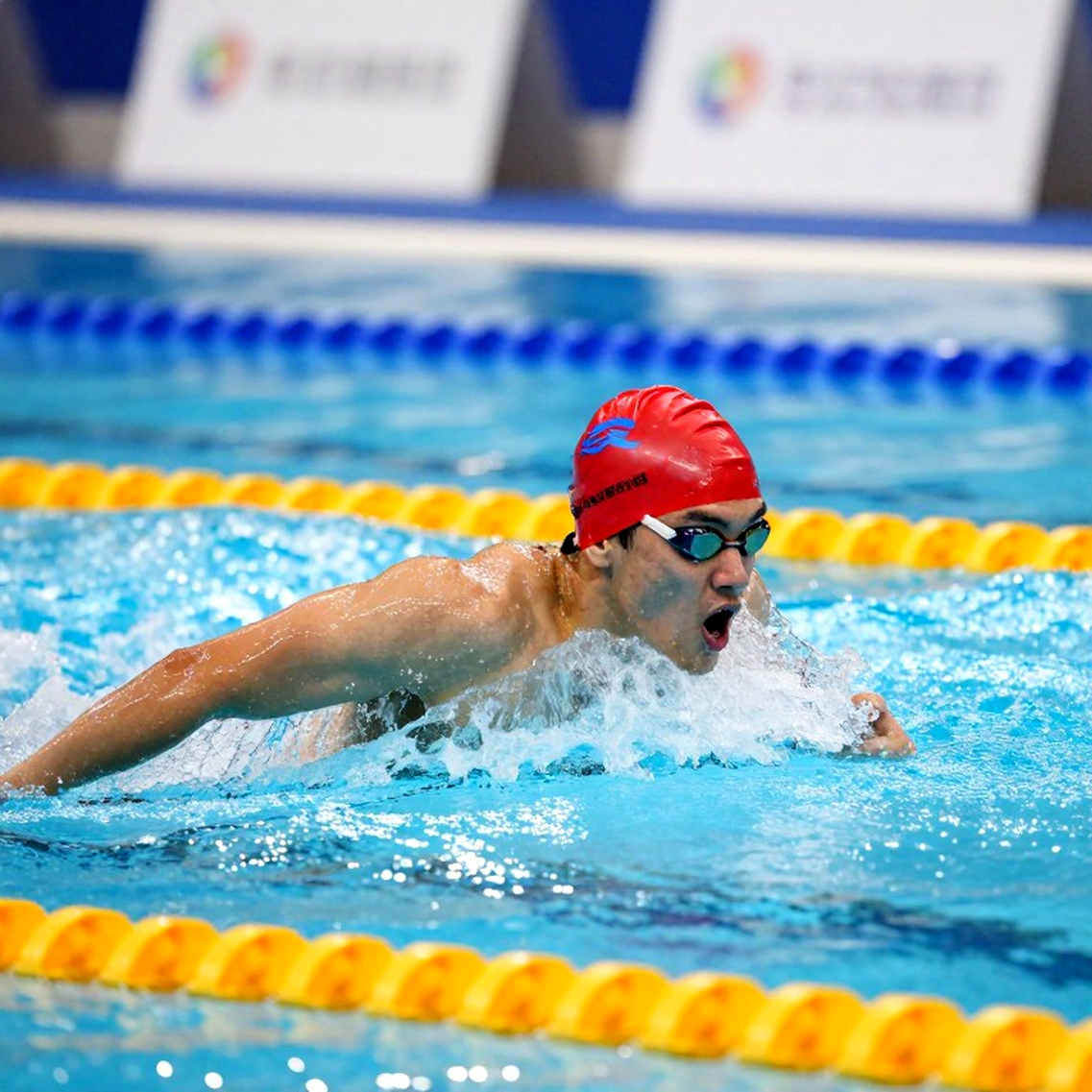
Ohashi contested at least four events here — 100m breaststroke, 200m breaststroke, two medley relays — across a five-day, 35-event programme. At seventeen.
That is admirable: it shows range and team value. It is also the most concrete risk. Shoulder and back load, a fragmented taper, and relay takeovers plus a one-false-start rule on every start. I am not raising suspicion; I am raising load management. A world record at seventeen means an extremely high ceiling and a slightly open door.
The biggest blank is who coaches him — the programme, the sports-science support behind it. In transfer-market language: data models overprice youth potential and underprice the system. We wrote the time and did not write the system, and the system decides whether he reaches an Olympic final in 2028.
Japan's pipeline and my country's ledger
Japan's model is a club-school-university hybrid — not the American NCAA model, not China's whole-nation system. Its breaststroke pipeline has signalled for three years straight: a Pan Pacific Youth sweep in 2026, World Junior relay gold in 2026, a world record in 2026. A staircase, not a leap.
I counted seventy-one golds before I trusted the list. In the winter of 2026, while processing district player registrations for the Rajshahi Divisional Football Association, I logged every result of the 26th National Swimming, Diving and Water Polo Championship into one spreadsheet over eleven weekends. Navy 38 golds, Army 17, BKSP 12, civilian clubs four.
I place that number beside Ohashi's 2:04.83 not to compare but to understand. One country builds a world record at seventeen through a pipeline; another spreads four of seventy-one golds to civilian hands through one ageing outdoor pool. The Mirpur complex still sits under open sky, and a world-standard indoor aquatic centre remains on paper.
The heaviest number here is not on a medal table. Roughly forty children drown in Bangladesh every day. In the crowdless year of 2026, I compiled drowning reports across Rajshahi division with a CIPRB/UNICEF SwimSafe field team — more than 1,500 child deaths in a year, most within 200 metres of a homestead. Cross-tabulated by upazila, month and water body, the pattern was monsoon and access, not negligence. In the year with no crowds, the numbers still filled the seats.
Ohashi's 2:04.83 and those fifteen hundred children in one article will discomfort some. Not me. Swimming is performance and survival skill at once; counting one while avoiding the other is the stranger act.
The contrarian angle
The first mistake will be reading this as "Asian swimming has arrived." It proves one system — Japan's — is producing at elite level. It does not prove continental depth. The opposite: 0.09 seconds between silver and bronze, and 3.84 seconds between gold and silver, expose the thinness. Correlation is not causation; one teenager's record is not the cause of a regional rise.
The second mistake is confusing structure with intent. Japan's result is structural — clubs, universities, competition, continuity. In my country the services' dominance is a structural fact: the Navy holds both the presidency and the only functional complex, so the outcome is systemic before it is personal. Without that distinction, the ledger stays an accusation instead of becoming a solution.
The third mistake is manufacturing a hidden story out of a 3.84-second gap. No doping allegation, procedural violation or suspicion appears in the record. A world record always triggers mandatory testing; that is the normal path. Ohashi's line — "many things happened before ASIAD 2026" — is unexplained context, probably injury or a training change. Drawing an inference from it is not my job; my job is counting.
The fourth mistake will come from local newsrooms writing tomorrow that if Japan can, why can't we — while never printing how many 50m pools exist, how many swimmers have actually met a qualifying standard, how many Olympic entries were invitations rather than times. My swimming ledger carries a ceiling two decades wide: roughly 24 to 26 seconds for the 50m freestyle, around 58 seconds for the 100m backstroke. Four decades of entries that never converted into one qualifying time. Ohashi's 2:04.83 is not a comparison to that ledger; it is arithmetic from another planet.
One lesson from my own work applies directly. A world record at seventeen does not reduce media attention; it builds an expectation dam. The history of collapsed prodigies is almost always the same story — not a shortage of talent, but the weight of body and expectation. Load accounting belongs in the column before the sky-touching editorial.
Takeaway
Two truths sit side by side on my desk because both are true: 2:04.83 is a genuine world-class time, and at a mid-cycle continental meet against a shallow field it is not yet stress-tested at Olympic-final pressure.
The real test is the 2027 World Championships against a full Qin–Marchand–Stubblety-Cook field. I will watch four numbers: ratification in the official timing archive, the rivals' response, a repeat within 0.5 seconds of 2:04.83, and the coach's name. Silence has a transfer value, and 2026 taught me to price it.
The question deserves asking here rather than in a closing paragraph: if a world record is built eight thousand kilometres from a country losing fifteen hundred children a year to water, then who is the sport actually for?